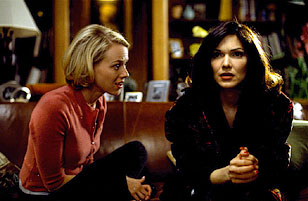
There was never love between Diane and Camilla. Camilla was just an actress that Diane attempted to seduce and take a hold of her personality. She wanted to be her, and tried to get under her skin. Diane is erotomane, schizoid, and delusional. Camilla is just an object, a stereotype of the Hollywood vamp. She might have never existed — she might have only popped out of a Gilda poster, fleshed out in Diane's delusional mind, like an imaginary friend.
Of course the Camilla we see at the dinner party could be a material support for her fantasy — this one existed, but her acting shows how she is indifferent to Diane, because they don't know each other that much, and Diane is doing all the talking: making up their common story while trying to cope with reality (Camilla was a real actress who got jobs, whereas Diane never got any). This scene is the climax of her confrontation with a contradictory reality, thus her breakdown. Hint: we don't see who's on the phone when Diane gets the invitation with Camilla's voice begging her to come over. This could be all invented in Diane's mind.
Diane is alone, and always has been. Nothing can prove those fantasized flashback sex scenes with Camilla ever happened but in Diane's mind. That is where the story with DeRosa, as her ex-girlfriend, becomes credible — DeRosa being the support for all the fantasy, and Diane's twisted mind transformed DeRosa into a perfect Camilla through a Gilda poster.
Whether the first part is a daydream, a nightmare or a mental delusion, Betty & Rita are another face of Diane's schizophrenia. Lynch shows how delusion changes and adapts, that there is no logic, the world collapses and creates a new reality.
That is why there is no evidence of Camilla's death. The kitchen apparition is another hint that Diane creates the characters out of thin air, but after the humiliation at the dinner party — when she finally confronted her fantasized stories with the real Camilla who is just a set co-worker — her mind has a hard time making this imaginary character credible again, and the fantasized Camilla (apparition) reflects Diane herself. There is no big deal about Camilla's death, concretely. Just rumors, thoughts, half-truths... if she really was a love affair, the woman she kills herself for, there would be much more predominance of her death — visually or through imagination. But ever since the Cowboy wakes her up, Camilla's death is blanked out. We only imagine that those hints lead us to believe she was murdered. But again, only Diane's delusional mind feeds us with the hints.
So Diane's suicide is not a passionate crime. It's a despair suicide because her inside world didn't meet the outside world anymore. — HarryTuttle
The theatre scene in the first part overemphasized the point that it was all a fantasy. I was particularly struck by the singer. She made us believe through her passion that things which happened after the illusion had been demonstrated were actually real. But she was faking too, and possibly this is a hint that the second part of the film — which "explains" the facts behind the dream — is just an alternative fantasy.
A woman in a run-down apartment in Hollywood having an affair with a movie star, who is about to get married to a famous director, is just as much a fantasy as the original dream. The way Diane entered the party, for example, was just as much Hollywood drama as the dream. As was hiring a hitman. The real story is that she split up with her lover who was the woman who answered the door when the women went looking for Diane.
There was an actress called Camilla who became very successful after beating Diane for a part, and there was an ex-lover. They weren't the same person but they became the same person in the two fantasies. The Rita we see was neither the Camilla who got the part nor the ex-lover. The wearing of the wig represents the resentment felt towards the ex-lover transferring itself to Camilla, who was actually blonde.
So how many people died in the film? Just one. Diane. Rita never existed and she never really knew Camilla. The body in the dream was hers. She dreamt her own death. One suicide of a failed actress. Two different Hollywood versions of the events leading up to her death, both fantasies, and possibly dreams. — craig-278