A number of reviewers have supposed that the first part of the film is Diane's romanticised, idealistic dream and the last half portrays the seedy reality. I believe the second part is another dream. There is almost no reality to which the film returns. The film is made up of two interwoven dreams, each presenting a different interpretation of the only event we know is real — someone has died, and it is probably a suicide.
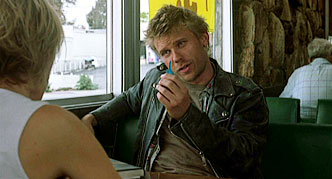
This interpretation is suggested first of all by the scene with Dan and his psychoanalyst in the diner. He has had two dreams, both of which lead him to the same place, both of which foresee his own death. It is tempting to see this isolated scene as a précis of the film as a whole. What we have here is a man awake, briefly, attempting to interpret two frightening dreams in front of an audience — his shrink — only to find that his two dreams were prophetic. He faces his own death at the point of realisation. The only connection of this scene with the rest of the film is that Diane sees Dan at that diner's cash register. This otherwise unconnected snippet is, I believe, a hint provided by the director to the interpretation of the rest of the film — which bears the same structure: a woman awakens briefly and sees two dreams (perhaps as she dies, à la American Beauty), which prophesy her own death, at which point in reality she sees the face.
The nightclub scene, like the Dan-in-the-diner scene, is another of the more analytical scenes giving a clue to what is going on. The nightclub MC explains that the show has all been recorded and then we are shown two demonstrations of this fact. A trumpeter plays a few notes but then falls over while the notes, from what we now find was a tape recording, continue playing. A woman comes on and sings a Roy Orbison song in Spanish with great emotion and it really looks as if she is singing. But when two people come on and drag her off stage we find that she too has only been miming. Rita and Betty, who are watching, burst into tears. They have reason to: the nightclub is explaining who they are, and what is going on in the film.
Thirdly, the presumption that the second half expresses "the reality of the situation" assumes a reality which is Hollywoodishly melodramatic and contrived. What is some woman in a run-down apartment in Hollywood doing having an affair with a movie star who is about to get married to a famous director? Where does she get the money to pay for a hitman? How would she even get to know such a cold, calculating gun-swinger? In his earlier films such as Blue Velvet and Eraserhead, David Lynch is described as the master of demonstrating the macabre of the mundane. Why would he resort to a reality thick with hitmen, limousines, and failed love affairs with film celebrities?
In that little piece of reality we are shown in this film — the sordid flat and the death, possibly by suicide — there is enough to provide material for two dreams. We are told that Diane used to live in flat 12. We see the anonymous next-door neighbour, one of only two characters in the film who maintains her identity. She is a rather dykey looking woman in both the first and the second half of the film. In the first half she says that Diane used to live with her and that she wants to pick up her things. In the second half she wakes up Diane to pick up her things. The irritable way she behaves in both these brief scenes is plausibly like the way one would expect an ex-lover to behave. It is also quite possible that the girl from number 12 leaves behind the blue key we see on Diane's coffee table — an event which would also signify the death or estrangement of her as a lover.
And moreover, there is a parallelism between Diane/Betty and Rita/Camilla that suggests they are parts of one and the same person. We see that both Rita and Diane pick up a name in a diner. Rita sees the name "Diane" and thinks perhaps that her real name is Diane. Diane sees the name "Betty," which is the name she is given in the first dream sequence. Both Rita and Diane have a lot of money in their purse with no explanation given of how it got there. Both Rita and Diane take, or are about to take, a bullet to the head. Rita's demise and the key on Diane's coffee table precipitate Diane's suicide. I think that Rita's demise is Diane's demise because they are the same person.
The first half ends with Rita finding a blue box in Betty's purse which fits the blue key in her own purse. Betty is mysteriously absent. Rita opens the box, and with the box falls into twenty seconds of blackness. If we are in Diane/Betty's dream, why is it Rita who wakes up out of it? It is clear that the dreamer is, at least for this part of the dream, identifying with the Rita character. This is certainly a dream — but perhaps it is more plausible to suggest it is not Diane/Betty's dream at all, but a dream experienced by Rita.
By the end of the film, two sides of the dreamer's personality have fallen back into the chaos that preceded them. And the one certain reality of the film is that a self-loathing woman comes face to face with her reality, the black face and death.
This assumption throws light on the reason why so many people have to die when the hitman kills his "brother" in the first half. In an apparently comic interlude, a hitman kills a man with long hair who has apparently survived the car crash (like Rita), then kills an overweight woman in the next office after a stray bullet passes through the wall, and is forced to kill a third person — the cleaner — before shooting up his vacuum cleaner. I suggest that the triple homicide mirrors the suicide of a woman in an apartment, which causes the death of her in reality and the death of her two alter egos.
If both lead females are, in both of their roles, fantasies, then "the real dreamer" is elsewhere. It is probably unfair to look for her, but I think she may be a much older woman, possibly similar to the lady on the balcony in the nightclub scene, or the psychic who came to Betty and Rita's flat. Further evidence: we are told that Diane came to Hollywood after winning a jitterbug contest. Unless she was really retro, that would mean she was in her teens in the 1950s, and around sixty years old at the time of the film's action. This explains why the director in the film is directing a 1950s-style film. This makes the film all the more macabre. Even the Diane at the end of the film is still a lot younger, a lot more chipper than the reality of the corpse and the black face that is felt at the end.