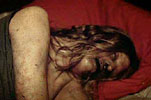
Dead girl — possible interpretations
- Diane is having a premonition of her own imminent death, probably an indication that she has been mulling over the possibility of suicide long before she ultimately does pull the trigger for real. Sitting depressed in her apt for weeks, suicide has naturally become a component of her dreams. Notice how in that scene, Betty/Diane is unmoved by the discovery. In shocking Rita she obtains gratification for what she feels driven to, putting the blame for her suicide onto Camilla.
- Diane is haunted by a vision of dead Camilla, showing her guilt/remorse over what she set into action. The body must have a connection to Camilla, being that the black clothing and red pillow reflect Camilla's colors, which are black and red.
- (A) and (B) simultaneously: A visual composition of sleeping Diane and dead Camilla (the waking-up realization that the hit's been done)?
- The decayed body can be seen as Diane's inner being, which has gone into moral decay.
- The rotting corpse is symbolic of the abused Diane. Note that when the Cowboy enters Diane's bedroom, the girl is alive... and the corpse is left as he leaves. → Cowboy = Diane's abuser?
Details of note
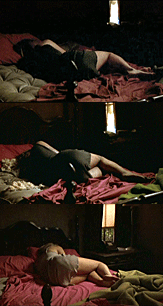
- The corpse is credited as Blond in Bed played by Lyssie Powell.
- It's not Diane's body: a different dress, matted/longer hair and it's not the same bed.
- We see the corpse once more when Diane is waking. In order: sleeping Camilla, decaying corpse, sleeping Diane.
Diane unwilling to acknowledge her crime
It's consistent within Diane's guilt-ridden dream to assume herself dead. With Mr. Roque repeatedly trying to reach her by phone, it's a visual clue to us, the viewers, that Diane is the godfather of this mafia of her dreams — it is she who imagines and creates such a conspiracy. She can't answer the phone, because if she did she would have to acknowledge responsibility for it all (this is a dream, I'm inventing all of this to repress my guilt). Thus she imagines herself dead (and reemerging as Betty) as to make herself incapable of answering any questions.
Prophetic dreams
Prophetic dreams, also referred to as precognitive dreams, are dreams that seemingly foretell the future. One rational theory to explain this phenomenon is that our dreaming mind is able to piece together bits of information and observation that we normally overlook or that we do not seriously consider. In other words, our unconscious mind knows what is coming before we consciously piece together the same information. In the dream Diane sees a dead body in her bed. Her psyche speculates that someone will end up dead there, but the inconsistencies of hair and robe color don't definitively dispel who's body it is.
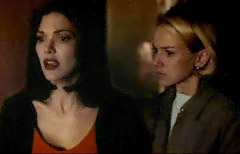
Looks like the "monster behind the wall" is the dead body of Diane. Dan's words sum up the impressions and the feelings behind this death that threatens Diane (a suicide is not spontaneous, but grows maliciously deep inside). What Betty cannot explain to Rita, but instead shows her the raw truth: the "God Awful feeling" is eating her up and will lead her to suicide. Consider the 2 scenes simultaneously: Lynch operates the same camera path, from the front door up to the far end of the bed (Betty has to go around the bed to see the corpse face). — HarryTuttle
Diane projecting herself in her dying dream?
One instance where the consciousness of the dreamer enters the unconscious state of the dream is when Betty and Rita visit Diane's apartment and find the dead body of a woman (who does not appear to be the real Diane, as she is a brunette and wearing a yellow watch). When presented with the last 30 minutes of the film the viewer learns that Betty is Diane, and in this realisation, concludes that Diane is in actual fact witnessing her own death, through the form of the relationship of the subject establishing a connection of the physical world (reality) to that of the non-physical world (dreaming). This can somewhat relate to the psychoanalytical theory of Introjection:
"The process by which the functions of an external object are taken over by its mental representation, by which the relationship with an object 'out there' is replaced by one with an imagined object 'inside'. The resulting mental structure is variously called an introject, an introjected object, or an internal object."
Therefore, using the theory of Introjection, one might assume that if Diane has already died, then within that moment of when death occurs, her dying state of consciousness becomes merged with her unconscious. Furthermore, it would seem that within the dream, Diane witnesses her own death in exactly the same way as when in reality Diane commits suicide and ends up in the same bedroom, laying on the same bed in exactly the same position as the dead woman within the dream sequence. Another point to consider is when Diane in the reality sequence does commit suicide, the way in which she is tormented by the old couple and is forced to walk backwards in a complete frenzy towards the bed and position herself before putting a gun to her head, seems rehearsed or as though she is reacting in a dream-like trance. In the case of Mulholland Drive, it is viable to suggest that by the formed psychoneurosis developed within reality, Diane constructs a fantasy world within her dream state enabling her to act out her desires, thus achieving wish-fulfillment. — SavageWalker
Related: Dying Dream / Afterlife Theory
Occurrences of a corpse
— ctyankee
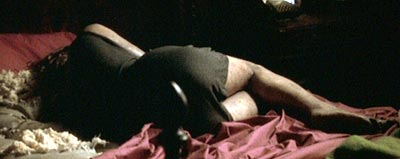
The first shot: Betty and Rita discover the corpse. Of interest, is that the P.O.V. shots for Betty and Rita is very close to the same view that the Cowboy sees later. We can also learn something from the credits (in order of appearance). Lynch doesn't credit anyone for this role — after the Woman in Apartment 12 is credited, the next credit is the magician. This could mean: (1) Lynch is hiding something; (2) there was no actor to credit — corpse was a prop; (3) Lynch didn't feel that playing dead deserves a credit. At this point, the corpse as a prop seems most likely.
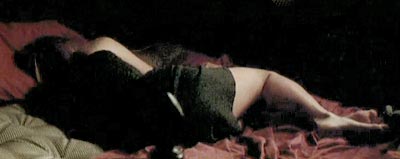
The second shot: Shows the body before the Cowboy opens the door and says something like "time to wake up... pretty girl." It is very unlikely that this girl is dead. Why? Her legs are in a different position than the corpse has them. Why would someone shift the legs of a dead person? Secondly, the shotgun holes in the mattress are not yet present. As noted, the Cowboy also seems happy to be seeing her. Lynch credits the role as "Blond In Bed" to Lyssie Powell. Lynch does not use the spelling 'Blond' in all of the MD pilot script — always 'blonde.' Is this a clue regarding the actual gender?
Comment: Actually, I prefer thinking that the dreamer is still on that bed (which would still make it a symbolic or dream bed) because no one has yet told me who they think that first woman is we see on the bed after entering that other world. — bellabuddy
Response: Having thought about it a bit, here is my take: Diane is the dreamer, Betty disappears and it is only the alone and terrified Rita that is in Aunt Ruth's bedroom. Diane is now dreaming Rita's story. Rita then falls into the blue cube and falls into a nightmare that interconnects Aunt Ruth's bedroom to Apartment Seventeen's bedroom. Rita is now having her worst nightmare where her worst fear is confirmed — SHE is the first body on the bed. — ctyankee
The third shot: Shows the corpse again. Then we see a somber Cowboy shutting the door. The "Blond" and the corpse also appear to have different clothes, with the "Blond" having a darker black outfit than the corpse.
My feeling is that we are looking at the same person as in the previous shot and that some time has passed (3 weeks?) between the shots. — blu-riven
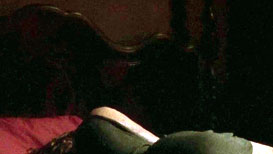
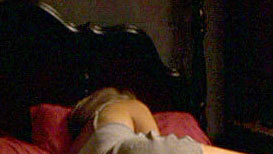
The fourth shot: Shows a sleeping Diane who eventually wakes up from the knocking on her door. Of interest is that the headboard is different. This one has a large bump in the middle and then slopes down to the side. The scenes with the corpse show a bump in the middle and then it curves/slopes down and then up again. This could just mean that they made a prop error or it could indicate that these are separate bedrooms made to look alike.
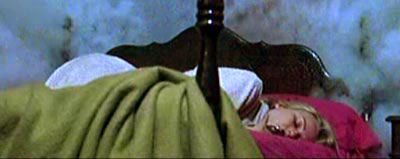
The fifth shot: Shows Diane as a corpse after she sticks the gun in her mouth. The headboard here appears to be the same one as the bedroom of a waking Diane. At this point, I don't know what to make of this. It could be that Lynch didn't think that we would notice the differences between the blond and the corpse. He could want us to notice that the timing of the cowboy shots are different (likely) but not want us to notice that the girls appear different and differently dressed. He could want us to think that it really is the same bedroom that Diane was in and the headboard is just a goof.
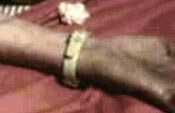
The link to the hitman is what I think speaks for her final stage being caught in prostitution. Neither an inexperienced girl from a small town — nor a waitress at Winkie's — is what you associate with contacts with a hitman. The hitman in the film clearly has connections with prostitutes, as depicted in the scene where the hitman looks for Rita: "any new girls on the street?" Both careers based on lovelessness. Further added to this is the haggard and worn appearance Diane has when waking up in her apartment, the pimp-like ambiance of the cowboy waking her up and the strap around the arm of the corpse (indicating drug abuse). — Anders Hellgren
Vertigo reference
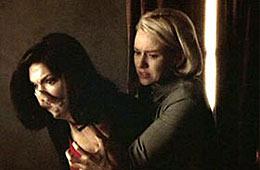
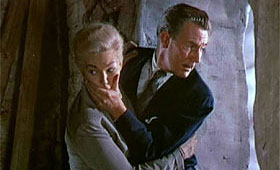
The scene with Rita screaming upon seeing the corpse is a reference to Vertigo (1958) by A. Hitchcock — warning: major spoilers ahead: In the particular scene (as the truth is revealed to us) from Vertigo, Kim Novak has just seen her doppelganger (the real Madeleine) fall to her death. If we are drawing conclusions from the clear visual connections we see, we maybe could deduce that Rita is doing similarly — Rita is looking at her dead self in bed. — blu-riven
One valid idea has been that Rita is looking at her dead self in bed. But, taken from a Vertigo reference standpoint, Sierra Bonita could represent the Mission San Juan Bautista where Scottie takes Madeleine (who is really Judy) to help with her vague memory of the place by seeing the place firsthand. In this case, Betty is trying to help Rita (who certainly isn't really named Rita) with her memories by taking her to Sierra Bonita. Further, Judy is a willing accomplice for Galvin Elster until the reality of her look-a-like death is upon her — with Galvin muffling her scream, Betty now muffling Rita's scream upon seeing her look-a-like dead before her. The aftermath leads to Judy changing her hair color from blonde to brunette. The aftermath in MD leads Rita to change her hair from brunette to blonde. — ctyankee